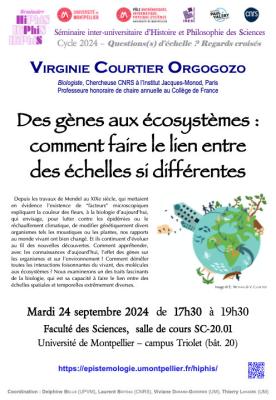
Virginie Courtier-Orgogozo is a research director at the CNRS, she leads a team at the Institut Jacques Monod in Paris (https://courtier.ijm.fr/), she is an invited professor at the Collège de France (https://www.college-de-france.fr/fr/chaire/virginie-courtier-orgogozo-biodiversite-et-ecosystemes-chaire-annuelle/)
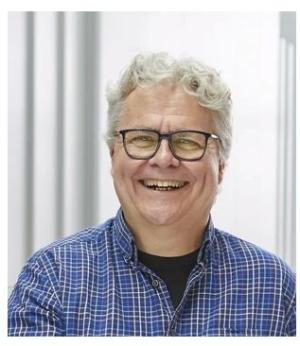
Nick started his career as a PhD student in the biochemistry department at Edinburgh University, and continued his training as a postdoc with Professor Wendy Bickmore. He started his lab in the Edinburgh Cancer Research Centre in 2006 with a fellowship from the Wellcome Trust and moved to the Human Genetics Unit in 2012 funded by an MRC Senior Fellowship. Nick is currently an MRC Investigator and holds a Wellcome Investigator award.
Orateur:
Pengyi YANG (University of Sydney, Australia)
IGH seminar room
Computational methods for stem cell biology and engineering
Computational methods are essential for characterising molecular programs that control cell-identity and stem cell-fate decisions. In this seminar, I will present our research on developing and applying computational methods for studying stem cells and stem cell-derived organoids. This will be followed by some initial results from using this knowledge and methodologies for cellular conversion and cell-fate engineering, a key foundation for tissue engineering, disease modelling, and regenerative medicine.
Orateur:
Carissa CHEN (University of Sydney, Australia)
IGH seminar room
Computational systems approaches to spatial and multi-omics analysis of tissues and organoid models
Defining the molecular networks orchestrating human brain formation is crucial for understanding neurodevelopment and neurological disorders. In the first part of my talk, I will present my research work on elucidating the molecular programs that drive this highly dynamic process by reconstructing molecular networks that control human cerebral organoids formation using trans-omics data. Next, I will focus on spatial transcriptomics data analysis and present our findings on comparing methods for detecting...
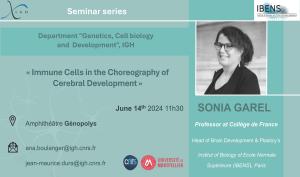
Immune cells in the choreography of cerebral development
La neurobiologiste Sonia GAREL, Professeure au Collège de France et Membre de l’Académie des Sciencesdirige depuis 2008 l'équipe « Développement et plasticité du cerveau » au sein de l’Institut de biologie de l’ENS (IBENS).Sonia Garel est pionnière dans l’étude des mécanismes qui contrôlent l'assemblage des circuits neuronaux du cerveau antérieur pendant l'embryogenèse et le développement postnatal.Ses fascinantes recherches montrent que l’activité cérébrale est régulée par des cellules immunitaires,...
Orateur:
John Diffley (Crick Institute, Londres)
Genopolys Amphitheatre
DNA Replication Forks and the DNA Damage Checkpoint
Le mardi 4 juin, à l'Amphithéâtre Genopolys, à 11h30, nous aurons un séminaire passionnant sur les dommages et la réplication de l'ADN par John Diffley (Crick Institute, Londres), « DNA Replication Forks and the DNA Damage Checkpoint ».
John Diffley, directeur associé du Francis Crick Institute de Londres, est un pionnier dans le domaine de la réplication et des dommages causés à l'ADN. Ses recherches pionnières ont permis de caractériser la réplication de l'ADN et à reconstituer in vitro ses...